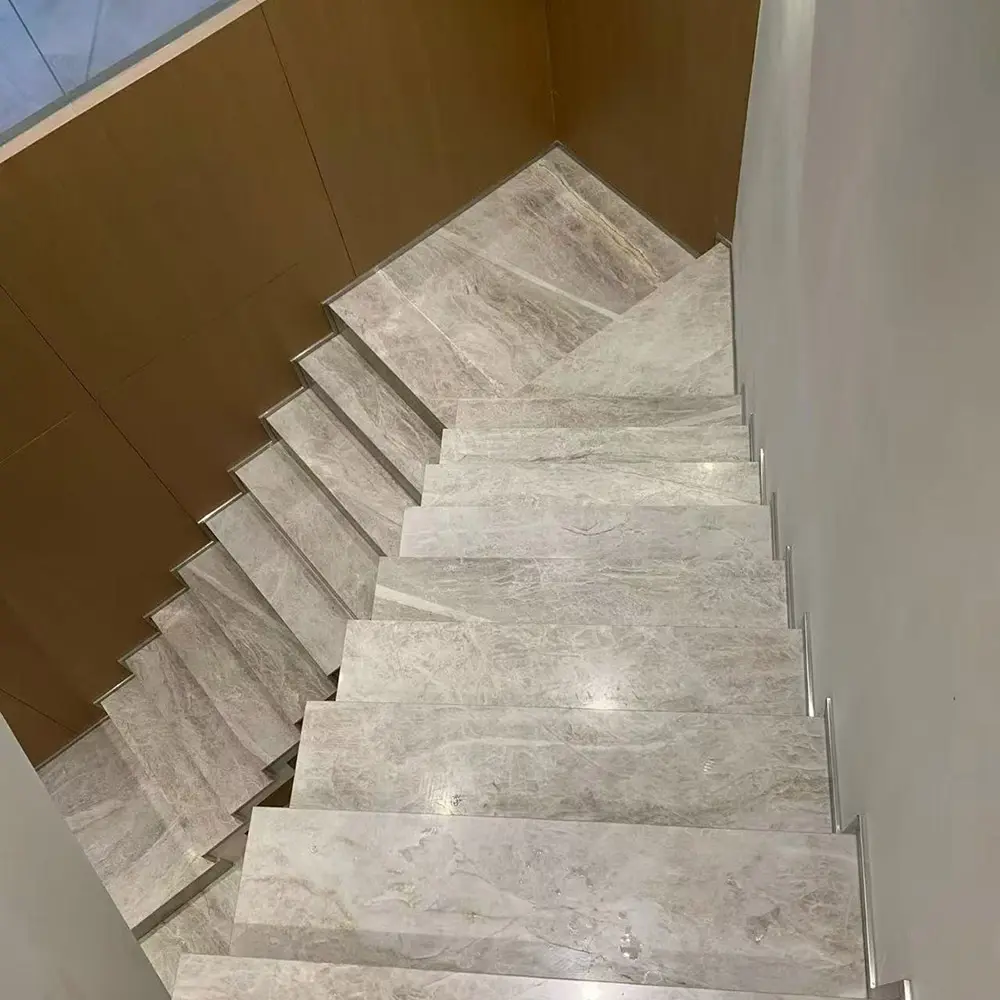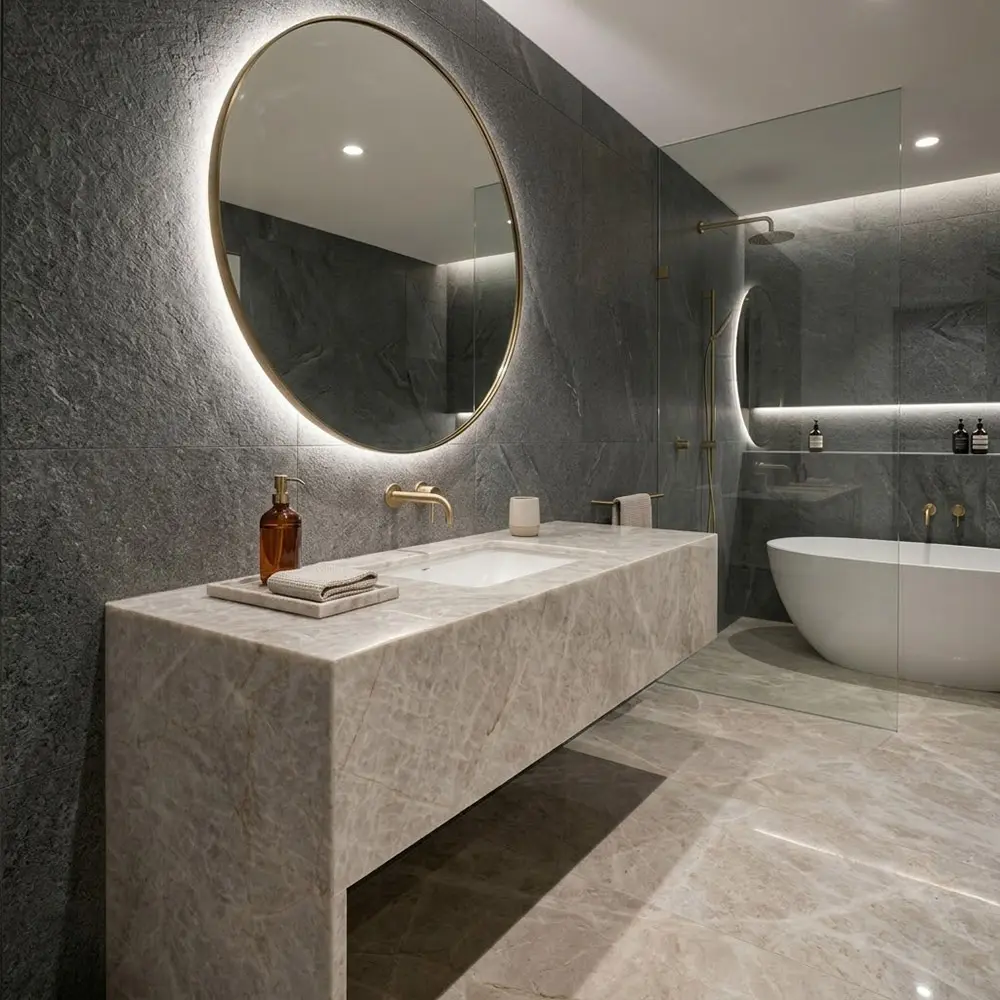






Buying marble looks simple until a project moves from a showroom photo to fabrication. Two slabs carrying the same commercial name can differ in vein density, background tone, fissures, resin treatment, translucency, available size, and cutting yield. Those differences affect not only appearance but also fabrication risk, joint layout, replacement planning, installation time, and total project cost. A serious buyer therefore needs more than a list of marble names. The decision should connect geology, slab dimensions, finish, intended use, quality control, and logistics.
This guide is written for importers, distributors, contractors, fabricators, architects, designers, and project buyers comparing Marmeren platen for real projects. It covers common marble families, commercial slab sizes, thickness choices, surface finishes, countertop and wall applications, batch approval, quality inspection, packaging, and supplier evaluation. If you already know your required material, quantity, thickness, finish, and destination, you can request a marble slab quote with those details so the sourcing discussion begins with measurable requirements instead of vague visual references.
The most expensive marble mistake is rarely choosing the “wrong” color. It is choosing a material whose physical behavior, available dimensions, or vein layout does not fit the fabrication plan. A dramatic white slab may be perfect for a hotel reception wall but inefficient for multiple small vanity tops. A dark marble can hide some stains visually but may show scratching or mineral variation differently under strong lighting. A very directional slab may create a spectacular island yet require additional pieces to keep the vein flow intentional. The buyer’s objective is therefore not to find the most beautiful slab in isolation, but the slab that delivers the intended design with manageable waste, acceptable maintenance, and predictable installation.
That is also why supplier capability matters. Buyers should understand whether the supplier can source blocks or slabs consistently, photograph or scan actual batches, organize dry layouts, calibrate thickness, process specified finishes, label pieces, and prepare export-safe packing. Before committing to a large order, reviewing the supplier’s natural stone sourcing and processing background can help you judge whether the company is positioned for one-off decorative pieces, repeat wholesale orders, or more complex project coordination. Capability should be verified against your own project requirements rather than assumed from a catalog.

Marble Slabs Buying Guide for Luxury Interior Projects
What Are Marble Slabs?
Marble is a metamorphic stone formed when carbonate-rich rock is altered by heat and pressure. True marble is commonly calcitic or dolomitic, and its mineral composition influences polishing response, acid sensitivity, color, and performance. Commercial stone markets sometimes use “marble” more broadly for other polishable decorative stones, so project specifications should identify the actual material and applicable test data where performance matters. ASTM C503/C503M covers marble dimension stone for building and structural purposes and evaluates properties such as absorption, density, compressive strength, modulus of rupture, abrasion resistance, and flexural strength.
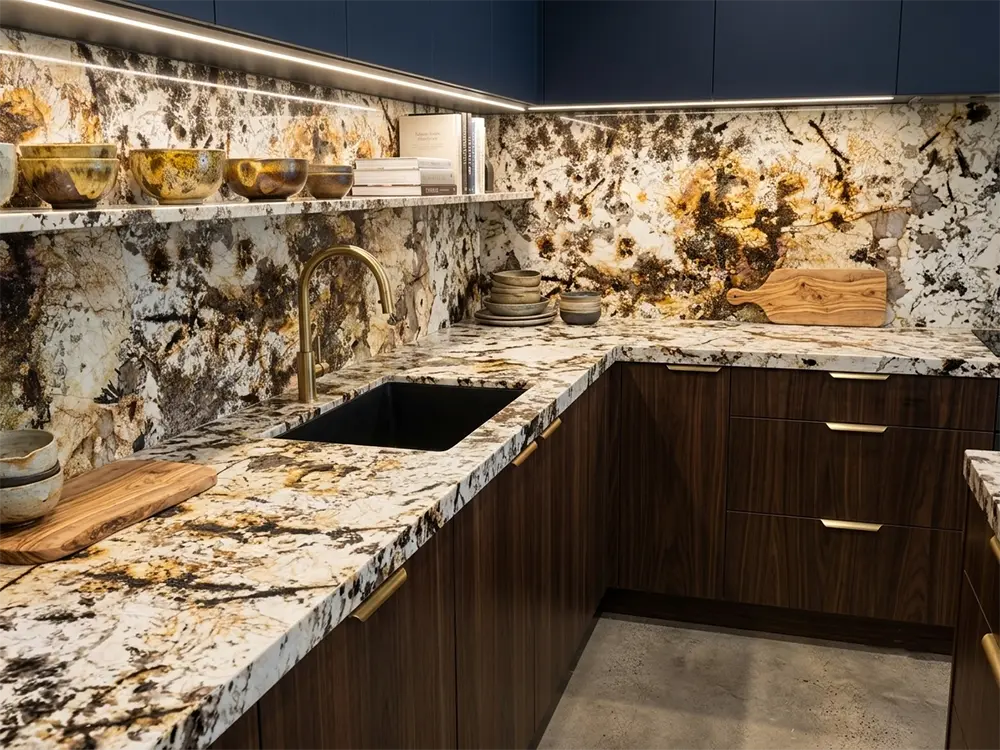
Large-format slabs are valuable because they preserve the stone’s natural movement across a broad surface. This is especially important on islands, reception desks, vanity walls, elevator surrounds, fireplace cladding, and statement furniture. When the project involves worktops, slab layout should be coordinated with sink cut-outs, cooktops, joints, overhangs, edge build-ups, and vein direction before cutting. For a practical application-focused overview, see marmeren platen for countertops, then compare those benefits with the maintenance expectations and fabrication risks discussed later in this guide.
Marble Slabs vs. Marble Tiles
Slabs and tiles serve different design and fabrication workflows. Slabs offer fewer joints, larger uninterrupted patterns, and greater freedom for custom cutting. Tiles are easier to handle in repetitive floor or wall grids and may simplify replacement in some installations. A slab is usually the better choice when the design depends on broad veining, bookmatching, custom dimensions, fabricated edges, integrated sinks, or continuous visual flow. Tiles are often more practical when the design requires modular repetition, easier field replacement, or smaller-format installation.
For buyers new to natural stone, the most useful first step is to understand that variation is not automatically a defect. Color movement, mineral lines, fossils, open veins, repaired fissures, and different degrees of translucency can be part of the stone’s natural character. What matters is whether these characteristics are acceptable for the intended application and whether the approved batch matches the design expectation. A broader gids voor natuurlijke marmeren platen can help establish the basic vocabulary, while commercial orders should go further by defining acceptance criteria before production.
Popular Types of Marble Slabs and Where They Work Best
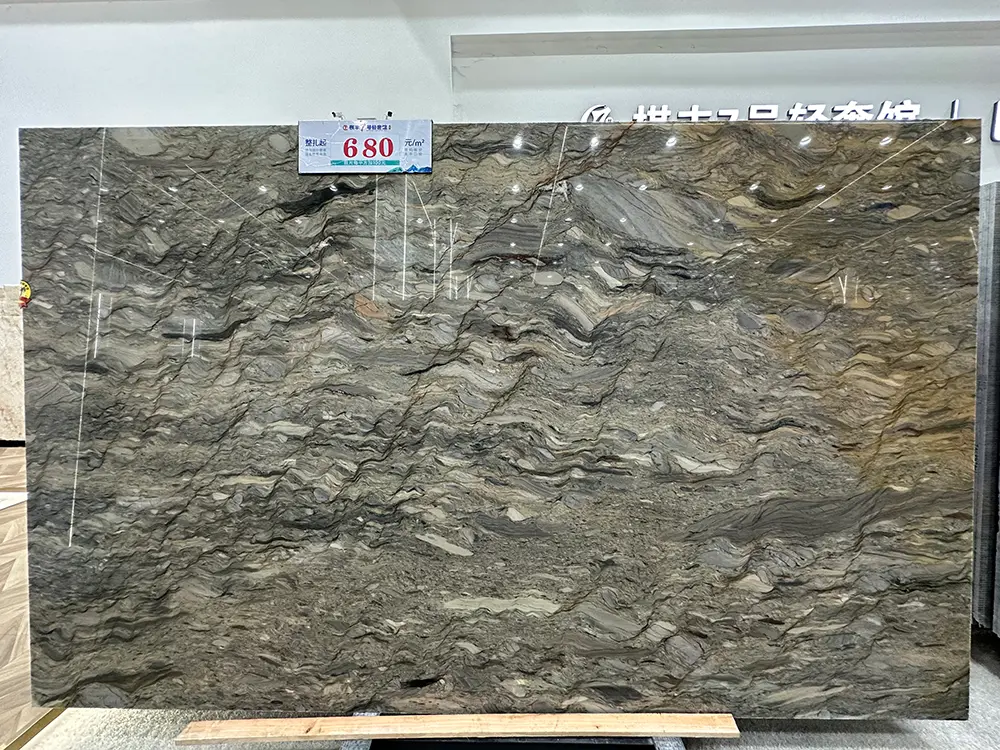
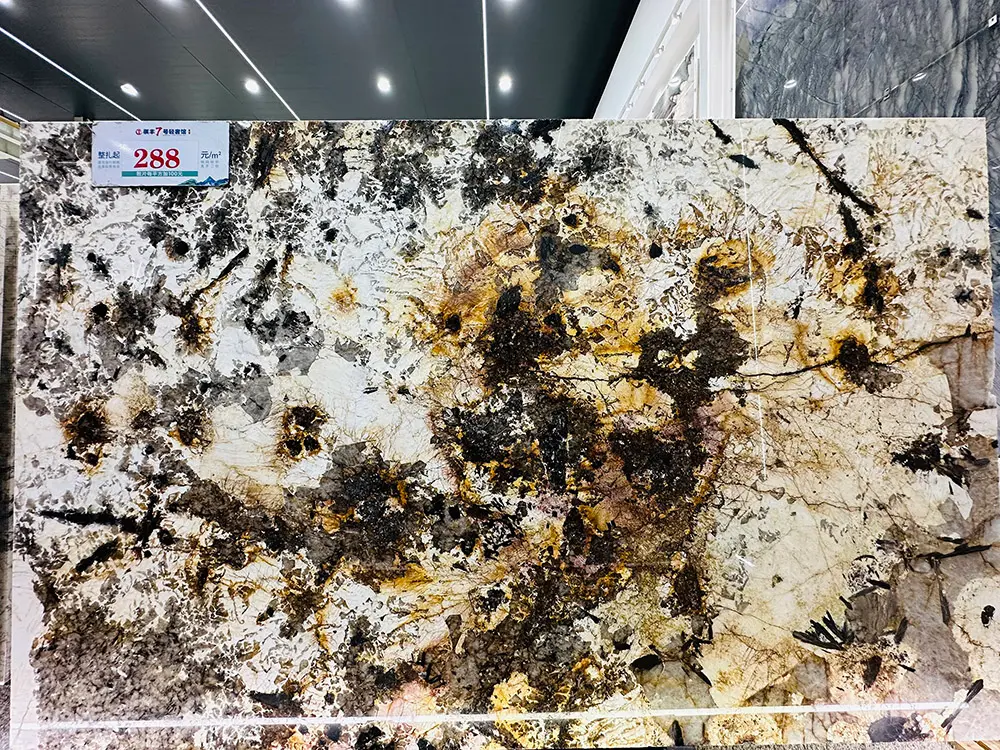
Marble should be selected by performance and visual direction together. Commercial names are useful for communication, but they do not replace inspection of the actual slab. Quarry face, block, cutting direction, batch, and finish can all change what the final material looks like. For wholesale and project orders, ask for current slab photos or videos, dimensions, thickness, finish, quantity available, and information about resin or mesh reinforcement when relevant.
International buyers also need to separate the stone decision from the sourcing decision. A good material can still become a poor purchase if the batch is mixed, thickness is inconsistent, slabs are poorly documented, or packing is inadequate for the route. Buyers comparing factories and trading channels may find it useful to review the workflow for sourcing marble slabs from China and then build their own inspection checkpoints around sample approval, live inventory, pre-production confirmation, and pre-shipment QC.
Witte marmeren platen
White marble remains one of the strongest design categories because it works across classical and contemporary interiors. Carrara-type materials usually show a softer grey field and relatively restrained veining, while Calacatta- and Statuario-type materials are commonly selected for stronger contrast, cleaner backgrounds, or more dramatic movement. These descriptions are visual families rather than universal performance grades. Buyers should compare actual slabs instead of purchasing by name alone.
White marble slabs for kitchen countertops can create a premium, light-reflective surface, but the buyer must accept that calcite-rich marble is sensitive to acidic substances. Lemon juice, vinegar, wine, tomatoes, and some cleaners can etch polished surfaces. Sealing can improve stain resistance but does not make marble acid-proof. If the client expects a completely unchanged surface under heavy food-service use, another material may be a better fit. If natural patina is acceptable and the design value is more important, marble can still be an excellent choice.
Dark Marble Slabs
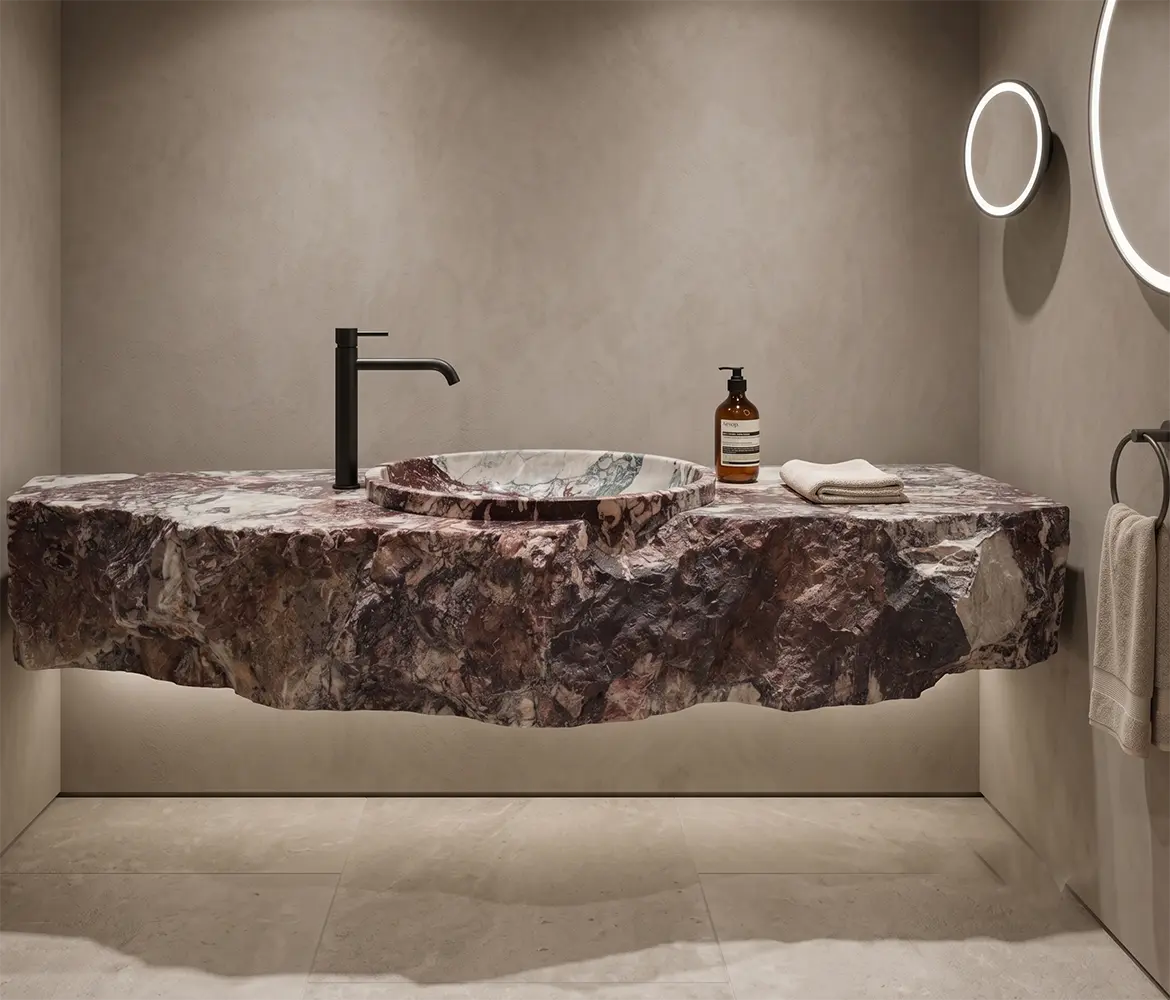
Black, brown, burgundy, and other dark marbles create strong contrast in bars, fireplaces, feature walls, hotel bathrooms, furniture, and reception areas. Dark surfaces can make white or gold veining visually stronger, but they may also reveal polishing marks, dust, water deposits, or scratches under directional lighting. For high-visibility commercial interiors, inspect the finish under lighting conditions similar to the installed environment rather than relying only on warehouse photographs.
Green and Multicolor Marble Slabs
Green, red, violet, and strongly patterned marble is increasingly used as a focal material rather than a neutral background. These stones are particularly effective for bookmatched walls, dining tables, consoles, bar fronts, powder rooms, and statement islands. Their design strength is also their procurement challenge: because the pattern is dominant, poor slab sequencing becomes obvious. Ask the supplier to identify consecutive slabs and keep the slab order documented from selection through packing.
Marble Slab Sizes: What Buyers Should Specify
There is no single universal marble slab size. Slab dimensions depend on the quarried block, cutting equipment, breakage risk, trimming, and the geometry of the stone. Commercial buyers often see slabs in approximate ranges around 2400–3200 mm in length and 1200–1900 mm in height, but premium blocks may produce larger pieces and some materials are naturally more limited. Treat these as market ranges, not guaranteed dimensions.
| Slab Requirement | Typical Buying Question | Waarom dit belangrijk is | Buyer Action |
|---|---|---|---|
| Length and height | Can one slab cover the visible surface? | Controls seams, vein continuity, yield, and shipping | Send finished dimensions and cutting drawings |
| Net usable area | How much remains after trimming defects or edges? | Gross slab area may not equal usable fabrication area | Approve usable boundaries on slab photos |
| Sequential slabs | Are consecutive pieces available? | Important for bookmatch and vein continuity | Reserve slab numbers as a set |
| Replacement stock | Will matching material still exist later? | Natural stone batches change | Order contingency pieces with the initial batch |
Choose Slab Size from the Cutting Plan, Not the Catalog
A slab should be evaluated against the actual cut list. For a kitchen island, the critical dimension may be the finished island length plus edge allowances. For wall cladding, the key question may be whether the slab can produce two vertically matched panels. For a table, the issue may be whether the desired oval can fit inside the usable stone while keeping the best part of the vein centered. Fabricators should nest pieces digitally or manually before final slab approval. This is one of the easiest ways to reduce avoidable waste.
Marble Slab Thickness: 18 mm, 20 mm, 30 mm and Beyond
Common international slab thicknesses include approximately 18 mm, 20 mm, and 30 mm, although availability varies by material and market. Custom thickness may be possible through sawing, calibration, or lamination, but buyers should not assume every marble is equally suitable for every thickness. Fragile or heavily veined materials may need mesh reinforcement, resin treatment, additional support, or a different fabrication strategy.
| Thickness Direction | Common Uses | Voordelen | Considerations |
|---|---|---|---|
| 18–20 mm | Wall panels, vanities, furniture, many countertops | Lower weight and often better material yield | May need support depending on span, cut-outs, and stone structure |
| 30 mm | Countertops, islands, tabletops, premium edge profiles | Stronger visual mass and more edge-shaping options | Higher weight, shipping cost, and handling demand |
| Custom calibrated thickness | Special architectural panels and precision fabrication | Supports project-specific assembly | Requires clear tolerance and measurement method |
Marble slab thickness for countertops should be chosen together with cabinet support, overhangs, sink openings, edge design, transport route, and local fabrication practice. Thickness alone is not a safety guarantee. A 30 mm slab with a weak natural fissure or badly positioned cut-out can still fail, while a properly supported thinner slab may perform well in an appropriate application.
Marble Slab Finishes: Polished, Honed, Brushed and Textured
Polished Marble
A polished finish deepens color, increases reflectivity, and makes veining visually crisp. It is widely used for luxury walls, vanity tops, reception counters, fireplaces, furniture, and other decorative surfaces. Polished marble is not the best default for every floor or wet area because slip resistance, scratching visibility, and maintenance expectations need separate assessment. Acid etching is also more visually obvious on many polished calcitic marbles because the etched spot loses gloss.
Honed Marble
Honed marble has a lower-sheen surface and often gives interiors a softer, more architectural look. It can make minor etching less visually dramatic than on a high polish, though it is not immune to staining or chemical attack. Honed finishes are often considered for floors, bathrooms, contemporary walls, and countertops where the client prefers a matte appearance.
Brushed, Leathered and Textured Finishes
Brushed or leathered finishes emphasize surface texture and can create a more tactile, less formal appearance. Textured finishes may also be considered where additional grip is desired, but slip performance should be confirmed using the relevant project standard rather than assumed from texture alone. Some delicate marbles do not respond uniformly to aggressive texturing, so finish samples are important.
If the priority is maximum visual depth and dramatic veining → choose polished.
If the priority is a softer appearance and lower gloss → choose honed.
If the priority is tactile character → consider brushed or leathered.
If the surface is in a wet or high-traffic area → verify slip, wear, and maintenance requirements before choosing the finish.
How to Choose Marble Slabs by Application
Keukenwerkbladen en -eilanden
For kitchens, the design question is not simply “Is marble durable?” but “Will the owner accept marble’s real behavior?” Marble handles normal household use well when properly fabricated and maintained, but acid etching is an inherent risk for calcite-rich stones. Busy commercial food preparation areas may demand a different material if an unchanged polished appearance is essential.
For a residential island or luxury show kitchen, marble can be highly effective when the client values natural veining and accepts patina. Select slabs with sufficient usable area around sink and cooktop cut-outs, avoid placing structural weak points across narrow bridges where possible, and review edge design with the fabricator. For dramatic islands, reserve consecutive slabs if waterfall ends or matching backsplashes are required.
Badmeubels en douchewanden
Bathrooms are one of marble’s classic environments. Large slabs reduce grout joints and can create a visually calm, premium surface. However, wet areas require careful substrate preparation, waterproofing, setting materials, joint design, and stone selection. Iron-bearing minerals or moisture-sensitive stones may discolor under unsuitable installation conditions. The installer should choose compatible materials and follow the relevant wet-area method.
Feature Walls, Fireplaces and Hotel Lobbies
These applications are ideal for using marble as visual architecture. The important factors are slab sequence, bookmatch potential, anchoring or setting method, panel thickness, support, lighting, and replacement planning. When a wall is designed around a symmetrical bookmatch, the buyer should approve the complete dry layout, not individual slabs one by one.
Furniture and Dining Tables
Marble tables require a different selection logic from wall panels. Weight, base design, edge vulnerability, movement during transport, and the position of natural veins matter. Large cantilevers or thin profiles may need engineered reinforcement. For furniture, stone selection should be coordinated with the metal or timber base before fabrication so that fixing points and load paths are understood.

Marble Slab Applications
Physical Properties Buyers Should Understand
Natural stone varies by quarry and even by block, so generic property ranges should never replace a project-specific test report. ASTM C503/C503M identifies key properties for marble dimension stone, including absorption, density, compressive strength, modulus of rupture, abrasion resistance, and flexural strength. Depending on the project, testing may reference ASTM C97/C97M for absorption and bulk specific gravity, ASTM C170/C170M for compressive strength, and ASTM C880/C880M for flexural strength.
| Eigendom | What It Tells the Buyer | Waarom dit belangrijk is | Procurement Use |
|---|---|---|---|
| Waterabsorptie | How readily the stone takes up water under the test method | Relevant to moisture behavior, staining strategy, and some installation conditions | Compare actual test data for the specified material |
| Bulk density / specific gravity | Mass relationship of the stone | Affects handling, structural load, and classification | Useful for engineering and logistics calculations |
| Compressive strength | Resistance to crushing under compression | Important in structural assessment but not the only predictor of slab behavior | Review where specifications require it |
| Flexural strength / modulus of rupture | Resistance to bending-related failure | Relevant to panels, spans, handling, and attachment design | Use with engineering design rather than as a standalone pass/fail shortcut |
| Abrasion resistance | Resistance to surface wear | Important for floors and traffic areas | Match to expected traffic and finish |
Veining, Color Variation and Batch Selection
Why a Small Sample Is Not Enough
A hand sample is useful for checking base color and finish, but it cannot show the full variation of a slab or batch. For heavily veined marble, a 100 × 100 mm sample may contain almost no vein at all, while the full slab may have sweeping movement. The reverse can also happen. Therefore, large projects should combine physical samples with current slab images, batch videos, and where possible a complete slab layout.
Bookmatching and Vein Matching
Bookmatching uses adjacent slabs opened like pages of a book to create mirrored veining. Vein matching is broader: pieces are cut and positioned so lines flow intentionally across joints. Both methods increase the importance of slab sequence and cutting yield. If the wall requires four bookmatched panels, the buyer should reserve enough consecutive slabs before fabrication begins. Replacing one slab later may be difficult because another block can have a visibly different pattern.
Dry Lay Approval
Dry layout is one of the best tools for controlling aesthetic risk. Slabs or cut pieces are arranged before final packing or installation so the client can review sequence, orientation, color transition, and obvious repairs. For premium work, number every slab and every cut piece. Keep the numbering consistent on drawings, photos, labels, packing lists, and crates. This prevents a beautiful layout from becoming a random puzzle at the jobsite.
How to Inspect Marble Slab Quality Before Ordering
Quality control should be linked to the agreed specification. “Good quality” is too vague for international procurement. Buyers should define the stone, finish, thickness, dimensional tolerance, visible repair policy, mesh/resin condition, edge condition, color range, slab sequence, usable area, packaging, and documentation.
| Inspection Item | What to Check | Common Risk | Recommended Action |
|---|---|---|---|
| Slab identity | Material name, batch, slab number | Mixed lots or incorrect selection | Photograph labels and map them to the order |
| Afmetingen | Length, height, usable boundary | Cut pieces do not fit the slab | Measure before final nesting |
| Dikte | Multiple measurement points | Fabrication or installation inconsistency | Specify nominal thickness and tolerance method |
| Flatness | Warping or distortion | Installation difficulty | Inspect on an appropriate support surface |
| Surface finish | Gloss consistency, scratches, texture | Visible difference after installation | Approve a finish sample and inspection lighting |
| Fissures and repairs | Resin, mesh, open veins, filled areas | Unexpected visual or structural weakness | Define what is acceptable for the application |
| Color / veining | Range and slab sequence | Patchy installation | Approve batch photos or dry lay |
| Verpakking | Frames, crates, padding, restraints, labels | Edge breakage or slab movement | Approve packing method before dispatch |
How Much Extra Marble Should You Order?
The correct allowance depends on the cutting plan, slab variation, replacement risk, and design pattern. A simple rectangular countertop layout may use material efficiently, while a bookmatched feature wall can require significantly more stone because the design controls which areas of each slab are usable. A fixed universal waste percentage is therefore unreliable.
As a practical planning method, calculate the net finished area first, nest every component into actual slab dimensions, add cutting kerfs and fabrication margins, identify pieces that must be vein-matched, and then add contingency stock appropriate to the project. For large commercial jobs, keeping spare matching pieces can be more valuable than minimizing initial waste because replacing a damaged panel from a later block may be visually impossible.
Installation and Fabrication Considerations
Substrate and Support
Stone performance depends on what supports it. Countertops need cabinets, frames, brackets, or other supports appropriate to the span and cut-outs. Wall and floor installations need a properly designed, constructed, and prepared substrate. The 2026 TCNA Handbook includes stone installation methods, wet-area guidance, mortar and grout information, substrate flatness considerations, and workmanship requirements. Project teams should select the method appropriate to the stone, location, substrate, and local code.
Adhesives and Moisture-Sensitive Stone
Some light-colored or moisture-sensitive stones may darken, curl, stain, or show adhesive-related discoloration if incompatible materials or excessive moisture are used. The installer should verify mortar or adhesive compatibility and follow manufacturer instructions. White setting materials are often considered for light stones, but the correct system depends on the actual stone and installation condition.
Cut-Outs and Edge Details
Sink openings, cooktop cut-outs, faucet holes, sharp internal corners, long overhangs, and narrow stone bridges all concentrate risk. Fabricators should use appropriate radii, reinforcement, support, and handling methods. A decorative edge profile also removes material, so thick or laminated edges should be planned before the slab is cut.
Care and Maintenance of Marble Slabs
Marble is usually classified as a calcareous stone because it contains calcium carbonate. The Natural Stone Institute advises using neutral cleaners and avoiding acidic products such as vinegar or lemon-based cleaners on calcareous stone. Acid can etch marble by reacting with the surface. Sealing may improve stain resistance, but it does not make the stone stain-proof or acid-proof.
Daily Care
- Blot spills promptly rather than spreading them across the surface.
- Use a pH-neutral stone cleaner or other product recommended for natural marble.
- Avoid abrasive powders that can scratch sensitive finishes.
- Use coasters, mats, and trivets where appropriate.
- Keep grit and sand off marble floors because abrasive particles can wear the finish.
Stains vs. Etching
A stain changes color because a substance penetrates or reacts within the stone. Etching is surface damage caused by chemical attack, usually visible as a dull or lighter patch on polished marble. Cleaning does not simply “remove” an etch because the finish itself has been altered. Minor etching may be refinished; deeper or widespread damage should be evaluated by a stone restoration professional.
Common Marble Slab Buying Mistakes and Their Consequences
Mistake 1: Buying from One Small Sample
Consequence: The delivered slabs may show much stronger veining, color movement, or natural features than expected. For decorative marbles, always review current slabs or the intended batch.
Mistake 2: Ordering Exact Net Area
Consequence: One breakage, cutting error, or unusable vein area can stop the project. Build the order from a real cutting layout and include sensible contingency stock.
Mistake 3: Specifying Only “Polished”
Consequence: Gloss level, resin appearance, scratch visibility, and edge finish may still vary. Approve a representative finish standard.
Mistake 4: Ignoring Slab Sequence
Consequence: Bookmatches and flowing vein layouts become impossible after random packing. Reserve and number consecutive slabs.
Mistake 5: Assuming Sealer Makes Marble Maintenance-Free
Consequence: The client may still experience acid etching, wear, or staining. Explain the difference between stain resistance and chemical resistance before specifying marble for demanding areas.
Mistake 6: Choosing the Lowest Slab Price
Consequence: A low unit price can be erased by poor yield, mixed batches, re-fabrication, replacement, delays, or breakage. Compare usable area, consistency, processing, QC, packing, and landed cost.
How to Choose a Marmeren platenleverancier
A supplier should be evaluated by how well it controls uncertainty. Natural marble can never be made perfectly uniform, but the buying process can still be disciplined. Ask who selects the blocks or slabs, how current inventory is documented, how slab numbers are controlled, what processing is performed in-house or subcontracted, and what inspection evidence is available before shipment.
Supplier Checklist
- Can the supplier provide current slab photos, videos, dimensions, and slab numbers?
- Can it reserve consecutive slabs for bookmatching or vein matching?
- Can it process polished, honed, brushed, or project-specific finishes consistently?
- Can it measure thickness and dimensions at multiple points?
- Can it provide cutting, edge, labeling, and dry-layout support where required?
- Can it explain resin, mesh, or reinforcement used on the selected material?
- Can it produce pre-shipment QC photos and packing records?
- Can it pack slabs appropriately for the route and unloading method?
- Can it coordinate replacement pieces using the original slab or batch records?

Natuurlijke marmeren platen by Color, Veining and Finish
What Information Should You Send for a Marble Slab Quote?
The fastest way to receive a useful quotation is to send a complete specification. At minimum, include the marble type or reference image, required slab or finished size, thickness, surface finish, quantity, application, delivery destination, and target schedule. For fabricated work, attach drawings and identify edge profiles, cut-outs, holes, vein direction, and any bookmatch requirement.
| Information | Example | Why It Helps |
|---|---|---|
| Material direction | White marble with bold grey-gold movement | Narrows the appropriate slab families |
| Toepassing | Hotel lobby wall | Changes finish, thickness, layout, and QC priorities |
| Finished dimensions | Panel cut list / island size | Allows yield and slab-size checking |
| Afwerking | Polished or honed | Affects appearance and processing |
| Quantity | m², slabs, or pieces | Determines batch reservation and packing |
| Destination | Port / city / country | Supports packing and logistics planning |
Marble Slab Decision Guide: If X, Choose Y
| If Your Priority Is… | Choose / Consider… | Confirm Before Ordering |
|---|---|---|
| Dramatic luxury feature wall | Highly directional white, green, violet, or multicolor marble with consecutive slabs | Bookmatch potential, slab sequence, panel layout, anchoring |
| Residential kitchen island | Large slab with suitable usable area and intentional vein placement | Etching expectations, cut-outs, support, edge design |
| Bathroom vanity | Honed or polished marble selected for the desired maintenance level | Moisture behavior, sealing, adhesive compatibility |
| Commercial floor | Stone and finish with documented suitability for traffic | Abrasion, slip requirements, substrate, maintenance plan |
| Custom dining table | Slab with strong central composition and appropriate thickness/support | Base design, edge vulnerability, shipping method |
| Lowest maintenance | Do not choose marble automatically; compare alternative materials | Chemical exposure, expected patina, cleaning routine |
Recommendation: Buy the Slab as a Project Component, Not a Pretty Surface
The best marble purchase is a coordinated decision between material, design, fabrication, installation, and maintenance. Start with the application. Then define slab size, thickness, finish, and aesthetic range. Review the actual batch, identify usable areas, plan cuts, reserve sequence-sensitive slabs, and document what has been approved. For performance-critical work, request relevant test data and use qualified designers, fabricators, installers, and engineers.
For wholesale buyers, developers, and contractors, the biggest savings often come from reducing uncertainty rather than negotiating the last few dollars per square meter. Clear specifications, slab-level documentation, realistic contingency stock, pre-shipment inspection, and appropriate packing reduce the chance of claims, remakes, installation delays, and mismatched replacements.
Marble Slab Decision Intelligence: What Buyers Should Know
This semantic summary is designed as a decision layer rather than another FAQ list. It connects material behavior, application fit, sourcing risk, compliance, and future market direction so buyers can interpret Marmeren platen in context instead of treating every slab as interchangeable.
What Defines a Good Marble Slab for a Project?
A good slab is one whose visual character, usable dimensions, thickness, finish, structural condition, fabrication yield, and maintenance behavior fit the intended application. “Premium” should not mean only rare color or dramatic veining. A visually expensive slab that creates excessive waste or fails to match the installation method can be a worse project choice than a more available material with better yield and documented performance.
How Should Buyers Balance Beauty and Performance?
Begin with non-negotiable technical constraints, then optimize appearance inside that safe range. For example, a hotel wall can prioritize bookmatch and visual drama because food acids are irrelevant. A kitchen countertop must account for etching and cleaning habits. A floor must consider wear, slip, substrate, and maintenance. This application-first logic prevents a common procurement failure: using the same selection criteria for every surface.
Material Fit by Product Direction
Legend: ●●● = Primary | ●●○ = Strong Option | ●○○ = Depends on Workflow | — = Usually Not First Choice
This table is an application-fit prompt, not statistical data. The symbols do not represent probabilities, laboratory scores, or percentages. Actual suitability depends on the specific stone, test data, fabrication, installation method, environment, maintenance expectations, and local project requirements.
| Current Product Direction | Countertops / Islands | Feature Muren | Bathroom / Vanity | Vloeren | Furniture / Tables | Buyer Consideration |
|---|---|---|---|---|---|---|
| Witte marmeren platen | ●●○ | ●●● | ●●● | ●●○ | ●●● | Excellent design flexibility; discuss etching and batch variation |
| Dark / Brown Marble Slabs | ●●○ | ●●● | ●●○ | ●●○ | ●●● | Strong contrast; inspect scratching and finish under project lighting |
| Green Marble Slabs | ●●○ | ●●● | ●●○ | ●○○ | ●●● | High visual impact; slab sequence is important for bold movement |
| Red / Violet Decorative Marble | ●○○ | ●●● | ●●○ | ●○○ | ●●● | Best used intentionally as a focal material; plan yield carefully |
| Translucent Decorative Stone Direction | ●○○ | ●●● | ●○○ | - | ●●○ | Often chosen for backlit or artistic use; engineering and lighting design are critical |
For a broad starting point within the site’s stone range, buyers can explore natural marble products and then request current slab availability for the exact project. Because natural stone inventory changes, product pages should be treated as material direction rather than a guarantee that a specific batch, slab size, or vein sequence is currently available.
Option Insight: When Is Marble the Right Choice?
Choose marble when natural variation, authentic mineral character, repairability by skilled stone professionals, and long-term aesthetic value are more important than perfect visual uniformity. It is especially strong for luxury residential interiors, hospitality, high-end retail, fireplaces, bathrooms, feature walls, sculptural furniture, and statement surfaces where the pattern itself becomes part of the architecture.
Option Insight: When Should Another Material Be Considered?
Consider alternatives when the client requires near-zero visual change under repeated acid exposure, extremely low maintenance, highly standardized repeatability across large future phases, or performance outside the documented capability of the selected marble. The correct answer may be granite, quartzite, engineered stone, sintered stone, porcelain, or another material depending on the use. A professional recommendation is sometimes “do not use marble here,” and that is better than forcing marble into the wrong workflow.
Consideration: Standards, Compliance and Documentation
For projects that specify performance, use the applicable standards and local building requirements rather than marketing language. ASTM C503/C503M provides a framework for marble dimension stone characteristics and physical requirements. Installation guidance may draw on TCNA methods, ANSI standards, adhesive manufacturer instructions, structural engineering, and local wet-area or anchoring requirements. In other markets, equivalent EN, ISO, national, or project-specific standards may apply. The responsible approach is to confirm which standard governs the exact product and use before approval.
Consideration: Sustainability and Future Market Direction
Stone purchasing is increasingly influenced by traceability, quarry and factory efficiency, water recycling, waste utilization, optimized cutting yield, durable design, repairability, and transport efficiency. Buyers should be cautious with broad environmental claims unless the supplier can document them. The strongest future direction is likely not “more marble at any cost,” but better documented stone, better nesting, less avoidable waste, longer service life, and clearer information about origin and processing.
Why This Buying Logic Matters
Marble is a natural material, which means uncertainty cannot be removed completely. It can, however, be managed. The combination of slab-level selection, application-specific finish choice, cutting plans, test data where needed, clear acceptance criteria, qualified fabrication, correct installation, and realistic care instructions turns natural variation from a procurement risk into a controlled design feature.
Frequently Asked Questions About Marble Slabs
1. What is the best thickness for marble slabs used for countertops?
For many residential and commercial countertop projects, approximately 20 mm and 30 mm are common slab thickness directions, while availability varies by stone and market. The better choice depends on cabinet support, span, overhangs, sink and cooktop cut-outs, edge profile, slab structure, transport, and local fabrication practice. A thicker slab can provide more visual mass and edge-shaping options, but thickness alone does not eliminate failure risk. The fabricator should review the actual slab and support design before cutting.
2. Are polished or honed marble slabs better for kitchens?
Neither finish is universally better. Polished marble gives stronger color depth and sharper veining, but acid etching may appear as a dull spot against the glossy surface. Honed marble has lower sheen and can make minor surface change less visually dramatic, although it can still stain or etch. If the homeowner values a crisp luxury look and accepts patina, polished may fit. If a softer, more relaxed appearance is preferred, honed is often a strong option. Cleaning habits and expectations should drive the decision.
3. How can I check marble slab quality before bulk ordering?
Check the actual batch rather than relying only on a small sample. Request current slab photos or video, slab numbers, dimensions, thickness measurements, finish inspection, information about resin or mesh reinforcement, and clear views of fissures or repaired areas. For projects requiring vein continuity, approve a dry layout and reserve consecutive slabs. Also confirm usable area, packing method, labels, and pre-shipment inspection records. Where engineering performance matters, request relevant test data for the specified stone.
4. How many extra marble slabs should I order for a project?
There is no reliable universal percentage because waste depends on slab size, finished dimensions, defects, cutting kerfs, vein direction, bookmatching, edge fabrication, breakage risk, and future replacement needs. The most accurate method is to create a cutting layout using actual slab dimensions, calculate net yield, and then add contingency stock based on project complexity. Highly patterned walls and bookmatched installations generally need more allowance than simple repetitive cuts because visual continuity limits where pieces can be taken from each slab.
5. What should I ask a marble slab supplier before placing an order?
Ask about current slab availability, origin, slab dimensions, thickness, finishes, batch consistency, consecutive slab availability, resin or mesh treatment, customization capability, quality inspection, packing, and shipment documentation. Send your application and cutting drawings so the supplier can evaluate whether the slabs will achieve acceptable yield. For international orders, confirm how slabs are numbered, photographed, protected, restrained, and listed on the packing documents. A supplier should be able to explain risks as clearly as benefits.
Referenties
- Standard Specification for Marble Dimension Stone, ASTM C503/C503M-23. Author: ASTM Committee C18 on Dimension Stone. Institution: ASTM International. Source: ASTM Book of Standards, Volume 04.07.
- Standard Test Methods for Absorption and Bulk Specific Gravity of Dimension Stone, ASTM C97/C97M. Author: ASTM Committee C18 on Dimension Stone. Institution: ASTM International. Source: ASTM Standards and Publications.
- Standard Test Method for Compressive Strength of Dimension Stone, ASTM C170/C170M. Author: ASTM Committee C18 on Dimension Stone. Institution: ASTM International. Source: ASTM Standards and Publications.
- Standard Test Method for Flexural Strength of Dimension Stone, ASTM C880/C880M. Author: ASTM Committee C18 on Dimension Stone. Institution: ASTM International. Source: ASTM Standards and Publications.
- 2026 TCNA Handbook for Ceramic, Glass, and Stone Tile Installation. Author: Tile Council of North America Technical Committee. Institution: Tile Council of North America. Source: TCNA Technical Publications.
- Care & Cleaning of Natural Stone. Author: Natural Stone Institute Technical Resources. Institution: Natural Stone Institute. Source: Natural Stone Institute Consumer Resources.
- Marble, Onyx & Serpentine: Technical Data and Best Practices. Author: Natural Stone Institute Technical Resources. Institution: Natural Stone Institute. Source: Natural Stone Institute Stone Types and Technical Resources.
- Dimension Stone Design Manual. Author: Natural Stone Institute Technical Committee. Institution: Natural Stone Institute. Source: Natural Stone Institute Technical Publications.